Showing posts with label General Commentary. Show all posts

Tuesday, June 19, 2018

June 16th Buster Keaton Day in LA!

I just got back from a whirlwind trip to Los Angeles for the dedication of a memorial plaque that was placed on the site where Buster's film studio in Hollywood had been and I'm still charged up by the experience.

This was such a lovely event and I am beyond grateful to those who made it happen! Because the great bulk of activities over the weekend were free or reasonably priced and open to all I brought my extended family along and we all enjoyed ourselves thoroughly.


One of the highlights of the event was the amazing and tireless John Bengtson who gave free walking tours of the area just south of Hollywood Blvd where Keaton (as well as Harold Lloyd, Charlie Chaplin and others) filmed numerous pictures. I was blown away. But better praise might be that the family members who are not crazed Keaton fans were also amazed and enthralled by the walking tour and Bengtson's deep knowledge of Hollywood history. If anyone reading this doesn't know about Bengtson's work -- sleuthing out the locations where movies were filmed long before there was IMDB telling us ;) or commentary reels from directors -- they should check out his site: https://silentlocations.wordpress.com/about-john-bengtson/

Another thing we did -- and I've always felt a bit sheepish about my desire to do this, so have never been there before -- was to see Keaton's grave. In the spirit of the weekend it felt like the right time to make the pilgrimage. Keaton is laid to rest in a stunningly beautiful area at the base of some brown hills that are a weird mix of craggy and rolling near Griffith Park tucked away in a part of LA that is truly lovely. The Forest Lawn Hollywood Hills location is extensive! I would never have found Keaton's plot without the pdf location map provided by the International Buster Keaton Society which planned the weekend's festivities. The grave markers there are mostly small, flat and modest, like Keaton's. This gave the impression almost of a military cemetery, with its striking uniformity and rambling, impressive grounds. It felt sweet and appropriate to be there offering our respects. I took a bit of bark from a Eucalyptus tree that was growing next to it. Haven't decided what to do with that yet, but since it's been riding around in my wallet for the last several days, hopefully there is something left beyond dust to work with!

After the cemetery and a quick bite to eat, we were up for another tour! Again with Bengtson, who must have clocked 20 miles and 20 hours over Saturday and Sunday, mostly canvasing the same ground repeatedly (and well-deserving of accolades) we learned about the films that were shot in and around Keaton's former studio location in Hollywood on Elinor Ave and Lillian Way.

I'd been to this area before but that was back in 2012, which I am now stunned to realize was 6 years ago! ... the year I started this blog. OK. gotta pause and think about that. ... Man. Alright, I'm back. A lot has changed in the neighborhood from the last time we were there. There is now a fairly significant homeless presence in something of a tent city that wasn't there in 2012. Also, while back in 2012, this area had seemed a bit forgotten, with a light industrial feel but empty streets and easy parking, it was now crowded, bustling and garbage-infused. While it wasn't immediately clear how much of the parking crunch that we encountered was due to the Keaton event itself, we couldn't have been the only reason. It turns out there's simply a lot going on in this area now, including a night club that people were waiting in line outside of and many, apparently thriving, businesses.

I was sorry that we didn't get to go inside the lot where Keaton's studio had been, but we did walk all around the exterior with Bengtson pointing out the sites. We were directed to look at this house that appears in ... well, I'm sorry to say I don't remember which film(s)! ... but something of note.  I will review my video clips and see if I can find it. lol. Pretty cool to see some building, any building, still present that had been a part of the backdrop scenery when Keaton was filming nearly 100 years ago.

On the site of the former Keaton studio (whose buildings were demolished in the 1930s) now sits a large warehouse utilized by a company called Quixote that does production supplies for films. I love knowing that this magical plot of land -- infused with Hollywood film history -- is still being used for industry-related business. Given the way the bustling surrounding worlds was carrying on around us, I was feeling particularly grateful that the current owner/tenant of the Keaton studio space was indulgent -- willing to get invaded by a bunch of Keatonians and endure the ceremony and plaque. Then I learned that the manager in charge of that location is himself a Keaton fan! So cool. Just another random little fact that seemed to fall into place and feel right.

Of course, the chief highlight of the Buster Keaton LA Weekend has to be the actual plaque dedication ceremony.

To anyone who isn't familiar with the backstory, in fact there was already a Keaton commemorative plaque at this location. It was dedicated in 1988. But unfortunately it was placed on the wrong corner -- a situation that many people felt needed to be rectified. The plaque had other problems too, such as being difficult to read. So a fundraising campaign was begun, spearheaded by folks present at the ceremony (such as Alek Lev and Patricia Eliot Tobias), and a great deal of effort I'm sure, involving permits from the City of LA and other logistics, was undertaken as a labor of love for many. I myself followed the campaign's progress with rapt attention and planned to be present at the unveiling if there were any way possible. Luckily, there was every way possible. We simply drove to LA for the weekend. I feel lucky, and again grateful, to have been in position to do this!

The ceremony was extremely well done. Everyone who spoke told a compelling piece of the story (except for David Arquette who, in a brilliant performance, remained silent. I'm kicking myself for not getting this on video, because his pantomime and pratfalls were a perfect tribute.)

What I did get on video is the moment of the unveiling....


As if all of that weren't enough... we also were thrilled to have the opportunity to attend a screening of The Cameraman at Grauman's Egyptian Theatre on Hollywood Bvld.

The weekend continued to fall into place with kismet. We found easy parking nearby then grabbed a quick bite to eat. We decided we didn't have enough time to seek out Keaton's stars -- both of which I'd already visited and photographed years ago. So I wasn't too troubled. But we did decide to cross the street and walk back to the theatre on the other side just to take in some new sights on the Walk of Fame. While doing so, we randomly stumbled upon Keaton's! And it was the movie one. My son had the idea for this great picture :)


And then The Cameraman. Seeing this on the big screen with other die-hard Keaton fans and an amazing live music accompaniment was a treat. This was only the second time ever that I've been able to see a Keaton film in an actual theater.

It is an experience which is palpably better in every way.

The laughs are bigger, Keaton's beautiful face is more present. The charm of the Yankee Stadium bit and the shots of Keaton running through the streets of New York hit their marks in a way that just can't be replicated on the computer screen. The Cameraman was a perfect choice and speaks to the obvious care and attention to detail poured into this event by its organizers.

We had a blast at Buster Keaton Weekend!
June 16, 2018
Buster Keaton Day in LA

Tuesday, February 20, 2018

"Roscoe" vs "Fatty" : A Fan's Thoughts on What's in a Name

Roscoe Arbuckle must be an interesting figure to any serious Keaton fan.


How can one have an informed love of the later without a bit of respect for the former? Assuming that the modern fan does (respect Arbuckle, that is), the question is what to call the guy.

Here is the one who gave our hero his start, who mentored him, who offered him a connection, friendship, a sounding board, a job. Here is a fellow without whom we might not have ever been able to indulge in the cinematic talents of Keaton! Arbuckle is a grand figure in the story of Keaton.

The more I read about Keaton, the more I learn about Arbuckle, and the more I feel the need to talk about him  . . . leading inevitably to the crisis that comes when one must refer to him as something other than a last name or a pronoun.

For me, up till this point, the moniker has always been "Fatty."


How I got to that name was straightforward enough. After discovering Keaton, back in 2012, my interest became insatiable. It wasn't enough to watch Keaton's films; I had to learn about his life including his early work. I had to watch the early shorts. Of course that lead directly to Arbuckle.

When I first encountered the connection, I admit that Arbuckle's name held a certain cache. He was a shadowy figure. I do remember him from my childhood. No, I'm not THAT old! but back in the 70s and 80s, silent films did play on TV and I have vague memories of hearing about him and, of course, the scandal. It wasn't the kind of thing anyone learned in school, but I'm sure it came up through my viewings and readings about early cinema. In fact, I vaguely remember a childhood friend telling me that Arbuckle had killed a girl. In any case, the name "Fatty Arbuckle" existed in my memory banks and probably held more associations for me than the name "Buster Keaton" did when I encountered each a few years ago.

All of this is to say that I didn't really question thinking of Fatty Arbuckle as "Fatty," any more than I questioned thinking of Buster Keaton as "Buster." (Or, I don't know, Curly of Three Stooges fame as "Curly.") It was just what he was called.

When one does stop to question this, of course, there is an obvious distinction - "Fatty" is clearly derogatory in a way the other names aren't.

Now I am not so insensitive to have failed to notice that in 2012, but there was a reason I stuck with the name "Fatty" when I referred to him in my writings. I read somewhere that "Roscoe" is what his friends called him and that "Fatty" was what his fans called him. That was good enough for me. I was going to class myself with the fans (which is what I was). I was not so pretentious to think that Arbuckle was my friend. So I went with "Fatty," but noticed there were others who called him "Roscoe." To me, that felt false - as if these folks were broadcasting an entitlement to a certain level of intimacy with the man. So I stuck with my choice.


But then, time passed. And I learned more.


During this past year, I started to do more reading about Arbuckle as I turned full attention to the Centennial year of Keaton's entrance into film. Because Arbuckle was such an essential player in the Keaton story at that juncture, I explored more and more Arbuckle-based materials. And I now realize  that there's a good reason for modern writers to call him "Roscoe."

Its goes beyond the idea that "friends called him 'Roscoe' and fans called him 'Fatty'" to the important reason why this was.  Arbuckle's friends called him "Roscoe" because he didn't like the nickname "Fatty." According to biographical accounts, Arbuckle didn't choose the nickname; and when people -- fans and the press -- started to call him by it, he at first tried to distance himself from the name. When he was unable to do so, he tolerated it for his career but continued to disdain it.

This alone might have been enough of a reason for me to switch horses and start using Roscoe, but a further consideration weighed even more heavily (pardon the pun). A new research project I'm working on (stay tuned) has given me reason to read a lot of media accounts of Arbuckle's activities in 1917. I have now read dozens of archival newspaper articles about the man, and in doing so have gotten a taste for the condescending way the media treated him, while ostensibly professing great admiration. This was long before the scandal that ended his career, back at a time everyone was charmed by him. By today's standards, newspapers were unfathomably impudent -- freely speculating about how much he weighed, peppering their accounts with reference to his size, speculating about damages he could cause or special equipment he might need. It's rather surreal. And honestly pretty offensive.

I have a newfound appreciation for the way not just the moniker, but the cottage industry of treating his size as an exhibit, must have grated on the man. In honor of that, I will refrain from it's unnecessary further use and call Arbuckle ROSCOE.

There's only so much one blogger can do when a century of history has established this nickname. But I'm ready to do my part.

So sad how much history this man's memory needs to live down!


Saturday, March 5, 2016

The Man With the Mostest

I really love a holistic approach to Keaton's work. An approach that respects his intelligent crafting of integrated and complete stories. An approach that recognizes that his body of work can't just be sliced and diced into easy snippets, for the youtube generation, but should be understood in terms of complete artistic endeavors, whole films at a time.

I really do.

             but . . .

Sometimes it's fun to think just about stellar moments, the briefest glimpses of stand-alone greatness. There are so very very many. Because when I think of favorite Buster moments, my mind gets a bit too flooded with images, I think its best to break this down into categories, like the Academy Awards for stellar clips.

So, I present my awards, in no particular order, for 25 of Keaton's  ________ -iest moments.


... Funniest
To kick off the list with funniest moment, I have to give the nod to One Week's house on the tracks. Of the untold thousands of major laughs Keaton has given us, none has surpassed this amazing scene from his first independent release. It is so funny because it is so surprising. And even though I know exactly how it is going to turn out, it still takes my breath away in laughter and surprise each time I watch.

... Bravest
Buster performed countless death defying feats -- so many I wouldn't even presume to rank their relative danger. So rather than make an award for most dangerous, I want to pick a winner for unabashed bravery, and award it to the waterfall rescue from Our Hospitality. This moment rises to the top as the bravest thing I've ever seen him do, because, seriously!, this man is jumping off the edge of a cliff, tied in the middle with a just a rope, into a plunging body of falling water, in order to thrust out far enough into the falls to grab hold of the doll that is standing in for a reasonable human that would never be caught dead even near this falls. I simply cannot fathom the level of utter fearlessness that allowed this moment to be filmed:


... Most Charming
Trying on hats in Steamboat Bill Jr. Ah, perhaps my favorite side of Keaton. The idea that the same fearless renegade who could complete the stunt above, knew how to scale it back and go try on hats with his dad charms me at a very deep level.


... Best Running
Through the streets of New York City in 1928 to see his girl in The Cameraman. This moment gets to me every time because who else ever could make the simple act of running (of course in this glorious backdrop) so entertaining? The answer is no one.


... Most Ahead of its Time
Sherlock Jr's split-self sleep walk. Wow, look at this unbelievably clever idea executed with extraordinary precision and skill. The whole film is a masterpiece of vision, engineering, camera-work and editing. This moment is breathtaking for very many reasons, not least of which is that this was made in 1924 and it is still completely convincing.


... Best Kissing
Le Roi des Champs Elysees has a kiss with a lot going for it. The part everyone talks about comes at the end when Buster gives us a smile, but it's not the reason I selected this moment. Rather, I like the way the kiss builds in stages and by the end a great look of carnal intent comes into his eyes before he grabs her and can be seen mouthing 'oh baby' (though this is not Buster's voice). A unique and treasurable scene. (Though I apologize for the terrible video quality).


... Best Almost Kissing
Bank scene in The Haunted House with a very pretty and coquettish young woman.


...  Fiercest
Battling Butler's I can't take it no more moment (which had been prefaced by several additional minutes of Buster first trying to avoid the fight and get away before), ripping loose and raging. I'm not sure there's anything like this in any other Keaton film and that's probably fine, because this one is so brilliant. A gorgeous and powerful moment.

... Saddest
Rescuing the girl in The Cameraman. Another somewhat unique moment because Keaton didn't do a lot of tugging at our heartstrings. But here he shows how incredibly well the man can sell heartbreak. This is a devastating moment in his canon.


... Best Engineering
The house in The Scarecrow. Tell me, how would you like to live here?


... Bestest Fall Ever
Steamboat Bill's coil of rope. There are no words :)

... Sexiest
The Cameraman's dressing room scene was almost the winner for the "funniest" moment, but I'm logging it here instead. It's not really actually "sexy" I suppose, in terms of their intent toward each other, but anyone with eyes must appreciate how, in addition to being one of the funniest things ever committed to film, this scene showcases Buster stripping, which has to qualify as sexy. I mean, yeah.


... Most Jaw Dropping.
The house in Steamboat Bill Jr.  I saw this film in a movie theater a while back, after having already been a Keaton fan for years. I had seen the scene dozens, maybe hundreds, of times as a clip and in the full movie. But I still gasped when it happened on the big screen in front of me. My jaw dropped as the house dropped. Beyond stunning.

... Most Romantic
The eyes have it in The Cameraman. Oh my. Incredible and beautiful. Both of them; and the camera work. Devastatingly romantic moment.

... Cleverest
Sherlock Jr's cut scenes. The intelligence and skill that went into these cut scenes just cannot be praised highly enough. Buster and his crack team demonstrate profound cleverness to have envisioned this sequence and to have given it such a full and perfect realization.


... Most Impossible to Ever Duplicate
Railroad ties in The General. I can hardly believe this didn't take off his head. Dangerous, yes. Brave, absolutely. Jaw-dropping, most clearly.  But this scene with the railway ties? it chiefly strikes me as something that will never ever, could never ever, ever! be done again.


... Yummiest
Yeah, we're going with the Hard Luck pool scene.


... Most Unbelievable
Cops' car ride. Yes, I realize I already have categories for "Impossible to Duplicate" and "Jaw Dropping" and maybe you're thinking this is getting redundant. But no, this is different. This special moment in time is light, hilarious and quick. In the blink of an eye, Buster vanishes on the back of a car, legs flying out behind him and all you can think is "Did I just see what I thought I saw?" "Did he really just do that?!"


... Most Athletic
Are you kidding me? Up and down how many levels on this boat? In how many seconds? Steamboat Bill Jr.


... Most gorgeous
MGM gives us a beauty shot and I thank them. <3 Spite Marriage.

... Most mesmerizing
Another great Keaton moment brought to you by The Cameraman, here is an incredible 3 minutes of Keaton pantomiming a baseball game at Yankee Stadium.


... Melancholiest
Rail riding in The General.


... Most self aware, a/k/a Best Failure to Smile
Go West. This has to be one of the cheekiest and ironic moments in his films. I love this scene 6 million loves.


... Best actual smile
A young Keaton enjoys making time with his flirty friend in drag, Fatty Arbuckle, in Goodnight Nurse.


.... Cutest
Kiss and run. I'll end this list where I began it with a scene from One Week and the cutest 1920s couple in the world Buster Keaton and Sybil Seely.


Disagree with my picks? Or have I failed to include some of your favorite moments? Please describe them here! I'd love anyone to share.

Sunday, February 14, 2016

Women Were Not Props

Something I've heard time and again -- from commentators who speak of his work -- is that the leading actresses in Buster Keaton films were no more than "props" to this great master.

This idea rankles and has always sat ill with me. I mean to take it on.

An unfortunate challenge with confronting this "props" theory, is that it seems to have been declared notably by Eleanor Keaton herself (see, e.g., 1995 interview with John C. Tibbets), possibly originating with Buster -- obviously formidable authorities. Others have repeated this so often that it has taken hold as a truism: Keaton's leading ladies were weak (as comedians), chosen mainly for their proportions, placed in scenes to be handled and molded, or otherwise of limited or diminished value. (See, e.g., LA Times Article quoting film historian David Gill).

But they have it wrong. Certainly there are some Keaton films where the leading female role is not central or essential, but I would never agree that, generally speaking, Keaton's leading ladies were unimportant or just props.
with Joe Roberts

Lets start with the idea that Keaton selected leading ladies for their proportions. Well, duh.

Keaton was a visual genius who chose many actors in his films at least in part for their physical characteristics. As Keaton must have learned early on while working with Fatty Arbuckle, the juxtaposition of himself with a tall rotund man is itself visual comedy. When Keaton struck out on his own, he consistently chose to work with Big Joe Roberts at least in part for this reason. And think about the hilarious relative size of 5'5" Keaton with Ingram B. Pickett, purportedly 6'11", looking almost like members of different species in The High Sign.  Consider, too, that Keaton knew what he was doing when he worked with Snitz Edwards as a sidekick, who was only 5 foot flat and made Keaton look big.

with Ingram Pickett
With similar attention to visual considerations but probably opposite intent, Keaton surely chose leading actresses whose size complemented his own so as not to introduce an element of comedy in a pairing when it was meant to be romantic and plausible where there was no wish to draw attention to stature. Obviously, Keaton also knew how to use physical characteristics of women as a source of comedy when he wanted to. That talent is on display in his scenes with a non-petite Kate Price in My Wife's Relations or with the tall, leggy, Charlotte Greenwood in Parlor Bedroom and Bath. Given all of this, I think an intelligent take on the generally petite size of Keaton's leading ladies is that this was a smart choice for non-distracting photographic symmetry in romantic pairings and that it need not be seen as evidence that their talent did not matter.
with Charlotte Greenwood

Though size may have been a concern in selecting an actress (or actor) to appear in a Keaton film, it can hardly follow that this was the only consideration and I take umbrage with the idea that a leading actress (petite or otherwise) needed only to be thrown about on screen to serve her role. First of all, if you take a look through his filmography, you might notice that Keaton truly didn't do that much manhandling of women in his independent silent work; certainly not in his silent shorts. Yes, this style of comedy came up in his later features, notably The General and The Navigator, but the scenes Keaton commentators (including himself and his wife) might have been thinking most about when they said he treated women as props could be those from his later MGM talkies, such as Spite Marriage, Parlor Bedroom and Bath, Speak Easily or What No Beer. These later films are undoubtedly ones over which Keaton had significantly less artistic control than he had in his independent silents, thus I am not sure to what extent he had much say in selecting actresses or determining plot details of those works. If other producers were responsible for selecting and creating roles for actresses in such talkies, I suggest they be held accountable for their choices with respect to women, not Keaton. :)

So now we reach the central question. Accepting: (1) that the fact that Keaton's leading ladies were small in stature is not alone dispositive on the issue and (2) ignoring films over which Keaton had minimal creative control, we can get to the heart of the underlying issue: were the leading ladies that appeared in Keaton's films talented in their own right? Did they add something to the productions, besides being manhandleable? I would claim that many if not most of these women are profoundly appealing on their own -- having charisma, charm, comedic chops and worthy screen presence -- and/or played roles that were essential to Keaton's finest work.

Starting with the numbers, I'm going to hold Keaton accountable for his treatment of women in 30 films (20 shorts and 11 features, including The Cameraman). Of those 30, I find the leading lady to be memorable and/or important for her ability to convey attributes that matter to plot or theme in all but a handful. Maybe 5 or so. And I am prepared to defend this.


I'll start with Sybil Seely, his costar in 5 independent shorts (including One Week, The Scarecrow and The Boat). Seely's presence is not uniformly well-utilized in all five of these movies, but is undeniably an essential part of the charm of the best of them: One Week. Were Seely just a prop, this movie would have been weaker by far. But she brings a heaping dose of sweetness, as a woman who loves her new husband and works tirelessly to inhabit the home they are making. She herself is a zen kind of presence, plotting her own course in her own home, cooking outside, drawing hearts on the wall, and demonstrating her irritation with this charming but frustrating man.  She is the young wife that wants to impress at a dinner party and stubbornly tries to pull her house off the tracks at the end. She is the reason we so want this house to succeed. It is her expectations, forbearance and frustration as well as her constant sweet love, that form the solid foundation upon which all the comedy lays. She is certainly no cardboard cutout, she is an essential part of the film. One would not care nearly so much about Keaton's endeavors to build this house were it not for this excruciatingly real woman who is the everywoman lens we frame the plot through. Seely showed great skill as an important teammate to Buster in the other movies she appeared in as well. In The Boat she adds a similar necessary element of partnership to the plot's function and interest. And The Scarecrow showcases her innocence, charm and companionship. The best of the films she appeared in are best precisely because her roles were allowed to be more fleshed out.
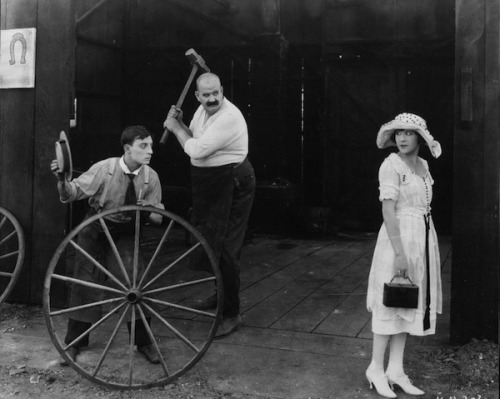
On to Virgina Fox who costarred in fully 10 of Keaton's independent short films including some of his very best: Cops, The Goat, and The Playhouse, to name three. Although Fox does not have the same personal charisma and charm of Seely, what she does have is a very strong, cold, aloof, counterpoint to Keaton's matter of fact directness. While I would argue that One Week is the best of his short films in large measure because Seely and Keaton together are an amazing team that sell the story so completely, I would also argue that Keaton himself displays his best comedic skill when he is solo, flying free. In films where a solo-Keaton is the point, the leading lady does not become inconsequential. Rather, she becomes important for an entirely different reason.  Fox -- because she is good at what she does in these exceptional films -- represents the conservative world concerned with propriety and appearance. She, like the world around him, is unfeeling and unimpressed. Unattainable. She is the opposite of a prop. In fact, Keaton hardly touches her in these (and other films) in which she appears. He can't -- though he might wish to -- because she is a part of something he can't quite have. Fox is essential because her personal style and performance choices allow this central theme of Keaton as societal outcast to be so fully realized. Keaton has to have known she was the perfect 'foil' in this way, because he used her again and again to fulfill that need. We should all be thankful to Fox for selling this untouchability so well because it forms the backdrop of much of what made Keaton, at his apex, great.

Others who've taken up the mantel I'm carrying here (that Keaton was not a sexist), have have often cited actresses like Kate Price (pictured right) and Phyllis Haver as women who broke the typical Keaton mold and exemplify feminine archetypes that are powerful. This is true. Kate Price was nearly 20 years Keaton's senior and while she may not have been meant to be taken seriously as a love interest for Keaton, how brave and endearing are the choices that let this fine actress share screen time as his wife in My Family's Relations. Price's engaging presence allows her to own her share of the film without question. Similarly, Phyllis Haver is often held up as an example of an extremely capable female character who inhabits Keaton's world in The Balloonatic. Haver plays a strong, outdoors-woman who is not a shrinking violet by any standard, but is hardy and real. These are examples showing that Keaton was not afraid to employ a strong-female lead for the right kind of story. And, although maybe not a strong, central female lead, I think we can also point to Bartine Burkett's interesting role in The High Sign as one that involved a quirky personality and acting choices that had little to do with what Keaton was up to (I'm thinking of her memorable turn as a ukulele-playing daughter.)

What all of the foregoing really points to is the broad diversity of female character types that were in fact employed by Keaton in the short films over which he exerted great influence and control. His choices were not uniform, but were wise and sharp and attuned to the skills of these women. Whether he even realized he was doing it, Keaton integrated the talents and features of leading ladies that added to any given plot or theme he developed in his films.


Now lets turn our attention to Keaton's feature length movies and explore some of the leading ladies who shared the screen with him in these 10 independent films.  I'll start with my favorite: Katherine McGuire, who starred in both Sherlock Jr and The Navigator. Having recently re-watched both of these great films, I simply cannot state strongly enough how much McGuire's presence enriched both for me, particularly in The Navigator, where she carries half the film as a collaborator on nearly equal footing with Keaton. Just as in One Week, where the presence of a team we care about sets off the gags and gives importance and meaning to what would otherwise just be "funny," the whole film The Navigator is enriched by a worthy partner. Much is written about Keaton's great 'saphead' character (used here as well as in other films), but it should not be forgotten that McGuire's own aristocratic ineptitude is necessary for The Navigator to work. She exhibits it in her attempts to make coffee, her setting off roman candles, her running around the decks of the ship in great abandon, and her sealing Keaton up into the scuba suit, to name a few moments. Her role isn't ancillary, but essential to the idea that they are a rather inept team that is up the creek without a paddle. But we nonetheless care about them! Their chemistry is palpable in part because McGuire is a charismatic, funny, and intelligent misfit and her fleshing out this character with real acting chops is necessary to our caring about what happens to the pair of them on this great big boat.

When people argue that Keaton was sexist in his choice of women's parts and leading ladies, I fume, because Keaton in fact often set women off as the more competent counter-point to his own character's ineptitude and struggles. It should not be forgotten that in Keaton's best movie ever,  Sherlock Jr., McGuire plays the woman who actually solves the crime, with simple, elegant competence, unlike her bumbling boyfriend. Also think of Anne Cornwall in College or Marceline Day in The Cameraman as examples of competent, modern-women (a college co-ed and a career woman) who are popular, charming and in control of their lives, while also expressing a warmth and caring that captures Keaton's heart. Strong capable intelligent women are all over the place in Keaton films.


I'll mention two other stand out performances from Keaton's independent features and then rest my case.

Marion Mack in The General. We are told at the beginning of the film that Buster has two loves: his girl, Annabelle Lee, and his engine, the General. Keaton's use of the locomotive is one of unparalleled gall, as he exhibits every bit of acrobatic skill and grace crawling up over and below this prop throughout the film. There is no question that the steam train makes a capable prop, but it is not a co-star.  And I am aware that this film has been oft-cited as an example of the love-interest-as-prop criticism I am taking head-on here. Yes, we see Keaton work tirelessly in, around, and with Annabelle Lee, as his second treasure, while she sits often bewildered in the center.  But this "woman as prop" take betrays a limited sense of what it means for an actress to make that happen. What I mean is, Mack was a flesh and blood human actress, not a steam train. It is absurd to think that being called upon to serve as love object in The General was an easy feat. If one is to say that an actress is "just" a prop in a movie like this, I would argue that one has never attempted to make just any actress act as a prop. Its like saying Jim Carey's face is just a face; just an object he uses to perform with. Saying so obscures the skill it takes to make this type of action look good. Marian Mack is a goddess.  She was called upon to inhabit and sell a character while performing physical stunts and having physical stunts performed in and around her. No one who wasn't a skilled physical comedienne could have pulled it off -could have taken on this role with such believability.  To the extent that The General shows us an example of a movie where Keaton goes crazy with his props, I think this serves to showcase the tremendous skill and talent of the actress who was at the heart of it all, selflessly allowing the action to proceed flawlessly all around her and just dealing with it.

So, yes, being a good prop should actually be viewed as hark work. But that said, I would stop and take on the underlying assumption that Mack was no more than a prop, a backdrop. In addition to being a game physical comedienne, she also played a woman who was a driving force, a locus of calm and determination, the lens of normalcy.  Mack gives us the same sort of willing participant that Kathryn McGuire had been in The Navigator -- a role that makes the viewer feel grounded.  It is her steady, up for anything, presence, picking out logs for the boiler, or sitting up all night with Keaton that makes us feel safe and connected to the action. Essential? Yes! There could have been no The General without such a female at the center with Buster.

Finally, we get to my other favorite Keaton film of all time, Steamboat Bill Jr. And what I consider to be one of Keaton's most appealing screen co-stars, Marion Byron. What a charmer! She is spunky, and cute as a button. She suits Keaton physically so well in this film, I just want to gaze at them together. She's the Meg Ryan of her time and I want to pick her up and put her in my pocket. Were someone to suggest that Sleepless in Seattle would have been just as good with any other actress, I'd say they were insane. Byron, like Ryan, adds a charm, and fanciful flourish to a part that is needed to offset Keaton's earnest, but more stoic endeavors. Byron enchants the audience with her charisma and makes us understand why it is so important for Keaton to be with her. As with some of the other Keaton leading ladies, she does actually get manhandled a bit here, and negotiates it extremely well. This is an incredibly appealing film, due in no small part, to the great screen appeal of Byron.


Finally, if you need one last push over the edge, I offer myself -- I mean my experience watching Keaton -- as testament. When I first started watching his silents, I enjoyed several Keaton films without the 'benefit' of any extensive reading or commentary about them.  I was highly surprised when I learned later that people were saying things like Buster didn't value his leading actresses or that he used them as props, because my own immediate response upon seeing his films for the first time had been: "wow, how cool that he was so enlightened and non-sexist in his portrayal of women." My first reaction as a modern intelligent woman, was that his films treated women in a modern, empowered and intelligent way.


I'll leave you with this: What Keaton did so exceptionally well in his independent work was to understand Story at a deep level. And he was fluid and pragmatic about what was needed to tell a story.  When a story called for teamwork, companionship and collaboration of an onscreen pairing, he utilized actresses that could provide a satisfying partner in the antics (think, McGuire in The Navigator, Seely in One Week, or Haver in The Balloonatic.)  When the story called for Buster to be a misfit loner trying to piece together an existence, free from cops and other entanglements, the leading lady was apt to be standoffish and capable of expressing a cool counterpoint that left Buster alone (think Fox in Cops or The Goat, or Ruth Dwyer in Seven Chances). Where the story was more romantic, and a leading lady was needed to sell an attainable womanly appeal and kindheartedness, the perfect choices were actresses like Byron in Steamboat Bill Jr or Day in The Cameraman.  And when, on occasion, a strong comedienne helped sell a story, Buster knew how to work with actresses like Kate Price or Charlotte Greenwood.

In most cases, these 1920s era silent film actresses shine with star quality, pluck and appeal that stands the test of time.

Saturday, July 28, 2012

Just up the road from the echoes: Chasing the feel of 1920s Hollywood

Its true what they say, there is no going back. Driving in LA in search of Buster Keaton's Hollywood, I realize that while you may be able to see the exact locations where his films were made -- thanks to the extraordinary research of John Bengtson -- it is impossible to really go there. Time drives relentlessly away from the quaint silent past, and in LA, more than anywhere else, the present is extremely loud and insistent. It just doesn't permit quiet reflection on bygone eras.

Even before going into this trip I knew, for instance, that Venice Beach would be unlikely to yield its silent echoes easily, but just how true that was would take me by surprise. Armed with a couple simple addresses from Bengtson's Book, designed to help me experience the place where Buster had filmed parts of The High Sign and The Cameraman, I thought I might grab a moment - just a second, even - of reflection on the changing landscape. To be charitable, maybe this would have been possible at say, 6 in the morning, but I can assure you that at 2 in the afternoon, it is not. It was all I could do to keep from losing my child, my backpack, and my mind while walking along what was once Ocean Front Walk and is now truly hell -- a funny sort of hell where strangers seem absolutely bent on getting you to take a flyer about their medical marijuana. (One of the odder things about this Venice Beach too was that it was sunny green blue and bright. So impossibly bright that it just felt wrong. It seemed to us that it should look black & white the way the world is supposed to -- but maybe that's another post.)

No, you can't find historic reflections in Venice and you certainly can't find them along Hollywood Boulevard. I didn't even try. Though I had a list of films that were made in and around Cahuenga and Hollywood Blvd and had originally thought we might linger at the intersection in an attempt to spot film locations, the desire to linger anywhere along Hollywood Blvd evaporated as soon as we got there.

You may wonder why I kept at it! . . . but, because I was so interested to see the Balboa Island area where Keaton had filmed many of his water scenes (in College, Sherlock Jr., The Cameraman, and The Boat) we went next to check out the (hopefully) idyllic tiny island just off the mainland at Newport Beach. Unfortunately, Balboa Island has to be one of the least peaceful places I've ever been. Every square inch of the 1/4 square mile island is covered with concrete or a house. I literally could not see the ocean for the houses and spent our whole visit simply trying not to hit anything with the car.

What I learned through all of this is that "finding" the past through actual film locations is extremely elusive. Luckily, what we found instead was so much better. Just up the road from the actual locations are real sites that are still evocative of Hollywood past. Locations that still seem imbued with a bit of what the 1920s had to offer and that present excellent alternatives to an actual film location tour. I call my tour "Up the Road from the Echoes" and it takes you to the places in LA where you can still pretend it is 1920.


Lets start with old Hollywood ambiance. Say you, like many others, want to find Old Hollywood on Hollywood Blvd, the place where dreams were made and maybe you've heard of the Hollywood Museum, billed as the place for early movie fans. Well, if you go, you might be impressed with the huge exhibit on Marilyn Monroe and the weird focus on movie makeup, but, if you are like me, and I hazard a guess you might be, you'll find the depiction of Hollywood in that museum distasteful and jarring. Glitzy, kitschy and seedy scenes meet your eyes under glaring lighting.  BUT, just up the street. . .

Try the Hollywood Heritage Museum. Here, located on a quiet strip of green grass next to a park and set inside an old wooden barn, you'll find a small slice of history. You'll learn about how the first movie crew began shooting the first movie in L.A. on Dec 29, 1913. You can see their photo. You can see two large film projectors that Buster Keaton once owned. You can see the silent equipment of Charlie Chaplin and a technicolor camera used in Gone With the Wind. Most importantly when you poke around in this museum you won't lose your soul. The place is relatively inexpensive, stocked with excellent books and a variety of old movie titles, smells pleasantly of earth and wood, and time. And while you're in the museum you can revel in your love of old movies and manage to feel intelligent all at the same time.

And because you're up and out of Hollywood Blvd you're away from the crowd. The best thing to do is keep going -- maybe keep going into a place called Hollywoodland. There you can visit what was still feels like a sleepy bedroom community. Hollywoodland was the original "Hollywood" of its day. The community that installed the famous sign in 1923 to attract attention and still has a small corner market and a little antique shop with early movie memorabilia. The famous sign is perched in the hills just behind the houses and, though the houses are gorgeous mansions, you won't see throngs of tourists waiting to feel the space, nor hordes of drivers clogging the streets. You can feel a slightly quieter hillside development than what you'd get down the road in Beverly Hills and you get to retain your dignity while looking.

And speaking of retaining your dignity, a perfect place for that can be found just north a couple of blocks from the absolute anarchy practiced at Venice Beach. Though it may have been a great place for filmmaking in 1922, there is almost evocative of 1922 along Ocean Front Walk now and certainly no reason to go there in search of past reflections.

BUT, just up the street . . .
Go a mile and a half north from the heart of Venice Beach. . . maybe to Wadsworth Ave or Hollister or the surrounding couple of blocks. What you'll find might surprise you: rows of lovely, preserved, 1920's era cottages, any of which it is easy to picture Buster Keaton running past fleeing the cops. You'll find a small local park sitting along the beach and your mind can supply the carousel from which he swiped a newspaper from a man. Several park benches line up just paces away and you can see him opening that newspaper to impossible dimensions. Its all just a short distance from where he actually did those things.

When you've tired of 1920s era Venice, and want a long car ride down the coast to places where you can find beach memories of the past, just keep right on going past Balboa Island.  . . . It's not far.

Maybe 5 miles south of where Buster used to shoot water scenes in his movies, you can dive right back in time to Crystal Cove. Here you'll find rows of cottages dating from the 1920s, some occupied by renters at this public beach and some existing in a more natural, time-eroded, state. The beach looks as if it were straight out of a movie. In fact movies were shot here -- if you walk into the little visitor center they'll show you a list. You can quite easily "see" the 20s at this unique and special little beach and when you hike out, notice that the hills on the other side of the highway even have the old-fashioned, brown, undeveloped look that you can picture Buster riding right through on the handlebars of a motorcycle.

The old style Hollywood may not be easy to find, but it is there in and around LA, you just have to look a little harder to find it than simply going to the locations where Keaton shot his movies.

However one place still does exist where the silent echoes are both real and tangible - it is the little area just south of the main drag in Hollywood where Keaton Studios was located.

Of course his square block studio was long ago demolished, and of course the surrounding buildings are all gone too, but the area retains an interesting light industrial feel. You're off the main drag; you can park your car and stroll around. It feels safe and pretty quiet. Although you'll see workers, no tourists are milling about. You can hear yourself think. I could totally feel the vibe of Buster running in and around, up and down these streets filming. In fact you can peer in to the lot where his stages would have been. Small-box buildings and out-buildings and light-machinery all sit on site. I found the place entrancing and am thrilled to see that much of the business taking place in the immediate vicinity of Buster's old studio is now movie-related again (prop houses, small studios, other supporting services). There must be a wonderful aura of genius still flooding the area after all these years -- the streets imbued with it.


A search for the past can take many forms. Many of us do it right from our living rooms by transporting ourselves into the past through movie magic. Others go in search of remnant buildings, street corners, spots where history occurred. I've found that when the present is too crowded to permit reflections on the past, going just Up the Road From the Echoes you can get a fuller flavor of what time was like "back then." It took a while and an excellent tour guide (thank you to my sister in law for her thorough understanding of the LA area), but I think I found the piece of the past that I was seeking. I'm now ready to go home.

Monday, July 16, 2012

Animal Magnitism

It is proverbially known that you can tell a lot about a person by how they treat animals. The lines of thinking are several: that it's a gauge of kindness and care; that it demonstrates selflessness to care for those who can do nothing for you; or that there's a slippery slope (if you could hurt an animal, its a short path to mistreating humans). These are probably all excellent reasons for paying attention to how people treat animals.

But for me there's a better approach to understanding character -- you can actually best tell about someone by how animals treat them.

Animals should be the litmus test because animals have very little self-interest. They are ready to give love wherever it can be bestowed worthily. They don't care about money, status, career or your friends. And they don't care if the picture is a flop. Animal love isn't readily faked. If an animal likes you, you are likable.

It should come as no surprise that animals loved Buster. Examples abound in his movies, but these are some of the best.

From his earliest days on screen, (The Butcher Boy, The Cook and The Garage) Buster began to forge a special relationship with Luke the dog based on chemistry and affection. But in Keaton's movie The Scarecrow, there is more -- a sense of mutual respect among performers. Luke was a smart dog with lots of film experience - and here is Buster shaking his hand in The Scarecrow to signal a truce in their shenanigans. Its a sweet and funny moment and it matters to the movie because Luke's respect probably actually mattered to Keaton.

The Blacksmith features a delightful scene where Buster treats a beautiful white horse to something of a spa day when a customer comes in wanting her shod. He shows the horse some shoes that aren't to her liking, then he selects some great strappy sandals and the horse is charmed. She even gets her nose powdered while the two seem to share a meeting of the minds. Buster and his equine friend hold court charmingly together for several memorable minutes.

In Go West, we get to see Buster's soul through the eyes of an adoring cow. "Brown Eyes" is beautiful and her clear desire to be near Buster is evident. You have to trust the cow, given that she cannot have cared about the movie biz. You might argue that she only responds to him in such a special way because he reportedly spent many days taking the cow everywhere he went, building her trust. Hanging out with a cow, huh? That seems to speak volumes itself -He not only cared enough to take the time to win the cow's love, but he was smart enough to know that it mattered.

You'd be hard pressed to find a cooler simian/human relationship than the one we get to enjoy in The Cameraman. Co-protectors, friends, and helpmates they are the most touching team. And play off each other with a beautifully seamless and natural style. The way that little monkey just clings to Keaton from the moment they meet leaves me speechless. And that's saying a lot.

Here is a man beloved not just by the masses, but by creatures great and small.