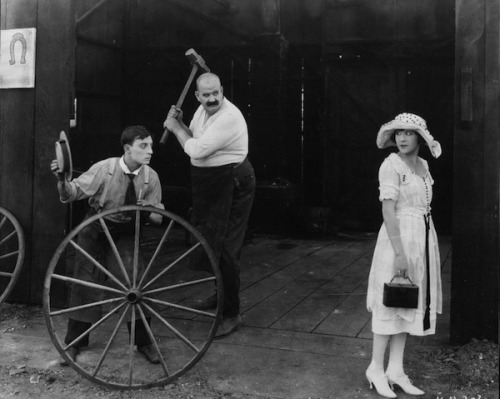
Sunday, April 3, 2016

Go West: An Underrated Keaton Masterpiece

Notice the wonderful lighting and Keaton's shadow on the cow

It's time to write in praise of one of my favorite Keaton films, Go West.  The first time I watched, I found it to be superb and fell in love with this gorgeously filmed ode to the desert.


But after reading other people's reviews, I began to wonder if maybe I'd gotten it wrong. One rarely sees this title ranked among Keaton's best; instead, folks give milquetoast or ambivalent reviews, seeing it as an oddity that stands off by itself. Take a look, for instance at what the briefest of Google searches for the title turns up in the page previews:
  • Buster Keaton's Go West doesn't quite compare to his best films but is an admirable stab at the funny bone nonetheless...  rottentomatoes.com/m/1089755-go_west/
  • Go West was an unusual film for Buster Keaton. With its portrayal of a down and out wanderer... www.silentfilm.org/archive/go-west
  • Some Keaton scholars have suggested that Go West is a subtle satire of Charlie Chaplin's approach... www.tcm.com/this-month/article/.../go-west
  • Go West is one of Buster Keaton's more low key films, but also one of his strangest... seoul-le-cinema.blogspot.com/2012/05/go-west 
  • Go West is a unique Keaton film even if it is not his most enjoyable... www.threemoviebuffs.com/review/go-west

In short, and as these snippets suggest, not only do people not love this film, but they seem to find it unusual or difficult to classify. Some say it is odd for Keaton to dip into pathos. Others suggest that Keaton is tongue-in-cheek in his poignancy and actually intended his film as a parody. The consensus seems to be that whether intentional or mocking, Go West is unusual: a slower paced film where Keaton tugs at our heartstrings in an attempt to make us sad.

But I can't agree.

Not because Go West isn't a slower paced film and not that it isn't unique, but because all of Keaton's films are unique. I would not grant that Go West is any less like the others, than those others are similar! (haha. How's that for a sentence?)  In terms of character, setting, plot structure and theme, Go West fits well in line with Keaton's other films, and doesn't seem to me appreciably any sadder than the rest. And in terms of its unique and special attributes. . . well, all of Keaton's films have their own distinct voices (funny word for silent films, but I'm sticking with it.)

Let me be clear: I don't mean to argue that Go West isn't on the slow end, the sweeping end, the calmer end of this array, just that there is no real reason to set it apart from the others and call it "unusual."  To do so implies that there is a Keaton style or formula that his other films follow and that Go West doesn't.  Maybe someone could make that argument, but for me, well, I don't see it.

Character:
For starters, "Friendless," Keaton's character in Go West, is right in line with his roles in other films. In character and approach to life, he is definitely Keatonesque: a bit out of touch and in over his head, but able to ultimately rise to the occasion. The young man in Go West is a typical blend of folly, zen-like determination and willingness: energetic, though inept, in his adopted role as a cow poke. Not particularly different from his turn as a willing, energetic and inept detective...(?) or for that matter as a willing, energetic, inept boxer...(?) news photographer...(?) college athlete... (?), scuba diver (?).

Though they tend to be alike in driving force, Keaton's young men cover a range of social positions, from the very rich (Battling Butler and The Navigator) to the more needs-driven (Three Ages or Go West). Some of his characters are middle class (College, Our Hospitality, or Steamboat Bill Jr.), some distinctly more working class (Sherlock Jr., The Cameraman).  While Friendless' poverty may place him at the far end of the status and wealth spectrum found in Keaton features, he is certainly not standing alone in left field.  And although he may have an especially solitary-sounding name, Friendless actually has more family connection (with at least a picture of a beloved mother) than some other Keaton characters do.

Plot/Theme:
With respect to plot, too, Go West explores typical Keaton themes of finding one's place in a complicated world just as Seven Chances, College, Sherlock Jr or Steamboat Bill Jr did. In fact, a couple of these films share very similar development: with a regular young man who has challenges to overcome, setting off on his own to try and find connections that exist only on paper or in possibility (e.g. a father, a family home, a better life). The films begin slowly as the young man encounters small new experiences then moments of growth, and finally, an opportunity to make a big difference in the lives of those around him he has come to care about, climaxing with a big finish that includes impressive stunts and hilarity. This pattern is highly Keatonesque.

Setting:
Finally, when it comes to that very special, big, sweeping, desert setting, I would simply argue that one could hardly declare a 'norm' for setting in the 11 great feature pictures Buster made. He set a couple in the Deep South, others in the big city; some take place in "Anytown, USA," others out camping, at college, on the wide open seas, or in a small river-town. There is no reason to declare the Arizona ranchlands outside this broad scope. Yes, the landscapes are wonderful, large and wide-open, in Go West, but other Keaton features have expansive and impressive natural landscapes too.


. . . and, all of a sudden I find myself in the silly position of starting to feel that this post is arguing that there is nothing remarkable about Go West!  That is the last thing I wish to do. I simply mean to suggest that Go West's attributes are not strange or weird -- not out of scope for him.


I will grant that Go West is unusual in one respect from his other features: It may be the only one in which Buster wears his signature porkpie for most of the film. The fact that he does this is itself telling of what I see as part of the genius of his intent with this film. (Which I hope to do justice to in a moment).

So, having spent all this time arguing that Go West is "normal," let me now shift gears and try to argue for why I find it special: an underrated masterpiece.


Here's the thing, though...

--well, let me step out of the narrative for another moment and share something with you that might make me seem a bit of a jerk: writing usually comes very easy to me.  I usually just open the computer and words and ideas come pouring out. I rarely struggle to get in tune with the big connections. But this one has been my hardest ever to write. I have really struggled to decide why, exactly, I love Go West. I'd been fighting this post on and off for over a month when it dawned on me (in the pre-dawn hours today) that the struggle makes perfect sense.  What I love about this film is hard to pinpoint due to the nature of Buster's great talent.  Silent film being the perfect expression for his ideas, slapping words atop it can just feel strained.

In other words, my struggle to verbalize its merits may be the most appropriate tribute to a fantastic piece of visual artistry.

But . . .
. . . I'm writing a blog here, so that's pretty much my job.   haha.  I'll do it, but I'm going to stop worrying about whether I'm making a good case for Go West.  Ultimately it stands on its own and the viewer who can get in touch with its gentle and profound loveliness can enjoy knowing they've tapped into something directly. If my thoughts help anyone reframe their expectations and experience as they watch, I'd be very happy about that, but I'm not sure I can sell its merits in a coherent way.


So, in short, Go West is brilliant for subtle reasons that aren't as tangible as plot or message, but as vague and amorphous as  mood,  heart,  balance,  and  contrast.


Brilliant Juxtaposition of Ideas
To elaborate a bit, One of the things Keaton does stunningly, ironically and humorously is to juxtapose elements that contrast a past/simple/calm world with a modern/complex/out-of-control one.

And this is where I think the pork pie comes in. By wearing his classic short-film prop and playing a character that is much more like those found in his earlier work (his short films), Keaton anchors us to the simpler time in his career - and in Hollywood. He begins the movie by placing us in a context that feels much like The Goat or Cops, with a funny and poor comic hero making desperate choices. But he goes even farther. He scales back our hero's life still more, stripping away all vestiges of modern comfort, leaving him with just a knapsack, a silly little gun, and a rapidly diminishing bread and sausage, then placing him in the starkest of surroundings.

Stunning composition
In the Arizona desert, everything around him is harsh.  Just look at the gorgeous, sweeping, grand expanses of the landscape. Our hero begins his awakening alone in this enormous dreamy place and soon after, he meets a cow.

Here is where the visual humor really blossoms. I find this shot, for instance, bursting with so much beauty and absurdity I can hardly stand it. This image is classic Keaton comedy. And Go West is full of such framings.

I would bet a lot of money that someone affiliated with making this film loved the desert. And maybe that's where the film best hits its mark: with desert-lovers.  I know about this breed of person because I am one.  As I write this, I am on a car trip crossing through western Arizona. I see landscapes around me that are almost indistinguishable from the grand vistas that provided the film's backdrop over 90 years ago. Maybe you have to love the desert to be fully in touch with its calm balance as well as its silliness. I don't know. But almost anyone should be able to appreciate that even in black and white (maybe especially in black and white) the desert scenery in Go West is very very lovely!

Yet the desert's role here isn't to be beautiful, but rather to be a powerful metaphor for simplicity, stability, and for lack of trappings; i.e. for the scaled-back life. I have to believe Keaton used this landscape with intention.

While in the desert, Friendless acts with a lovely zen-like acceptance of his new world. He never looks hot or miserable; he just jumps right in. Keaton's holistic and natural approach to the landscape and its creatures is a common and very charming theme he explores in many films. Supreme examples here are his patience, absurdly waiting for a cow to give milk or for a chicken to lay an egg. These bits are humorous and are also a study in contrasts/double purpose. Yes, they highlight Friendless' ineptitude when it comes to doing what the world expects, but they also showcase the enormous sweetness of this man in his approach to the scaled back life. (By the way, for the reader who may be interested, I did a post a while back on Keaton's relationships with animals in his films. As great as Buster's symbiotic pairing with Brown Eyes the cow is, she is just one of several amazing animal co-stars for him.)

Notice that Friendless becomes more and more competent as the film wears on and manages to evolve into an extremely useful worker who (in foreshadowing of The General) bravely hops on a train and defends it (and his love, Brown Eyes the cow) against robbers.  But, the contrasts continue, because as Friendless steps up his game, greater levels of chaos take over the film. The biggest contrast of all is in comparing the gentle desert beginning to the great comedic sequence near the end of the film, when Keaton is in the middle of downtown LA with a herd of cattle tearing up the city. What a perfect metaphor for the crazy upheaval of modern life. It (to me) is no coincidence that in this setting we get Buster in a devil costume and Fatty Arbuckle in a cameo. Keaton brings elements into Go West that we may not have seen in a while -- like the porkpie hat, the squad of cops on the chase scene (one of the extras even does a Keystone Cops jump while he flees). Keaton subjects these images of Hollywood past to the crazed antics of a herd of cattle.

Even in the mid-1920s, Buster was part of an industry that was rapidly changing. He may have had no inkling of the revolution that was just around the corner with sound, but he could not have been immune to the way Hollywood was getting too self-important for its own good.

At the time of this film, Buster's great friend Roscoe Arbuckle had already fallen victim to backlash against Hollywood's excesses. The fact that Buster hired Arbuckle for an extra in this film (present, but hidden) is telling. Arbuckle's cameo is not as a farmhand in the serene desert, but as a casualty of cattle blasting through downtown LA.  Coincidence, I think not.

If Go West is a study in the contrast of simplicity with excess, it is also a study in contrasts of scale. Buster explores contrasting scale through gags (the tiny purse-gun in the big holster) but also through stunning composition, highlighting the contrast between himself and the ranch owner for instance, or between himself and his cow and the enormity of the desert backdrop.


And finally, when it comes to his main storytelling theme in Go West (one he explores frequently in his films) -- of finding a sense of place, this film hits the nail square on the head. Just as with contrast and scale, Keaton develops the idea of "place" multidimensionally. He uses plot and character, to develop Friendless' story arc as he finds a home and real love; but, more strikingly, Keaton explores the theme of finding place visually.

I didn't really notice this outright until a recent viewing, but Buster is often framed by windows, gates and doors in this film. These openings are viewfinders allowing us to place him, to frame his experiences on the ranch with respect to what is around him, to what he sees and to how he is seen by others.  Here are just a few of my favorites, but there are others.


These shots are brilliant, and they are subtle. Here is a perfect example of how Keaton could bring an idea to life with such poetry using the medium of film with total attention and artistry, allowing us to experience something without being hit over the head with it.

I would not make the claim that he necessarily or directly intended all the symbolic meaning that can be found in his imagery, but he nonetheless created it.  Keaton certainly approached Go West, as he did his other films, with a supreme attention to detail that simply has to be appreciated, regardless of what level of meaning you find there. I believe that Keaton had very little in the way of artifice or pretension when he worked, so I'm not sure he created his masterpieces with a plan for symbolic thought, but rather through a pipeline to pure natural artistry.

I would argue, though, that Keaton intended at least some of the self-aware commentary that is found in Go West. My proof comes from the celebrated moment I'll call the "failure to smile" scene.

This is a hilariously on-the-nose moment in which Keaton's character accuses another cowhand of cheating at cards and the cowhand says to him with a vicious look on his face, "when you say that, smile."  The camera closes in on Keaton's beautiful face which betrays perfect consciousness that this is impossible. The scene is clearly playing to his audience's knowledge of Buster's screen persona. And Keaton celebrates the moment deliciously by slowly staring at the camera, then taking his fingers and pushing up the corners of his mouth and slowly shaking his head. It's one of the most brilliant comic ideas Keaton had: witty, ironic, flawlessly filmed and acted. Its a top-notch moment in silent comedy. And it is completely and ironically self-aware.


So, yes, I love Go West. I love it for its beauty. For its cheeky self-awareness. For the simple harsh hot stillness of the desert landscapes and all they stand for. I love it for Buster's once again showing us that he is in control of the picture and that he has a heart for simple creatures. I love that he used Fatty Arbuckle while tearing up downtown LA. I love his shadow on the cow and his fingers on the corners of his mouth. If you need more than that to love a film, I'd say "look elsewhere;" but if this sounds like enough, I'd suggest another open-hearted viewing for this "typical" Keaton gem :)

Saturday, March 5, 2016

The Man With the Mostest

I really love a holistic approach to Keaton's work. An approach that respects his intelligent crafting of integrated and complete stories. An approach that recognizes that his body of work can't just be sliced and diced into easy snippets, for the youtube generation, but should be understood in terms of complete artistic endeavors, whole films at a time.

I really do.

             but . . .

Sometimes it's fun to think just about stellar moments, the briefest glimpses of stand-alone greatness. There are so very very many. Because when I think of favorite Buster moments, my mind gets a bit too flooded with images, I think its best to break this down into categories, like the Academy Awards for stellar clips.

So, I present my awards, in no particular order, for 25 of Keaton's  ________ -iest moments.


... Funniest
To kick off the list with funniest moment, I have to give the nod to One Week's house on the tracks. Of the untold thousands of major laughs Keaton has given us, none has surpassed this amazing scene from his first independent release. It is so funny because it is so surprising. And even though I know exactly how it is going to turn out, it still takes my breath away in laughter and surprise each time I watch.

... Bravest
Buster performed countless death defying feats -- so many I wouldn't even presume to rank their relative danger. So rather than make an award for most dangerous, I want to pick a winner for unabashed bravery, and award it to the waterfall rescue from Our Hospitality. This moment rises to the top as the bravest thing I've ever seen him do, because, seriously!, this man is jumping off the edge of a cliff, tied in the middle with a just a rope, into a plunging body of falling water, in order to thrust out far enough into the falls to grab hold of the doll that is standing in for a reasonable human that would never be caught dead even near this falls. I simply cannot fathom the level of utter fearlessness that allowed this moment to be filmed:


... Most Charming
Trying on hats in Steamboat Bill Jr. Ah, perhaps my favorite side of Keaton. The idea that the same fearless renegade who could complete the stunt above, knew how to scale it back and go try on hats with his dad charms me at a very deep level.


... Best Running
Through the streets of New York City in 1928 to see his girl in The Cameraman. This moment gets to me every time because who else ever could make the simple act of running (of course in this glorious backdrop) so entertaining? The answer is no one.


... Most Ahead of its Time
Sherlock Jr's split-self sleep walk. Wow, look at this unbelievably clever idea executed with extraordinary precision and skill. The whole film is a masterpiece of vision, engineering, camera-work and editing. This moment is breathtaking for very many reasons, not least of which is that this was made in 1924 and it is still completely convincing.


... Best Kissing
Le Roi des Champs Elysees has a kiss with a lot going for it. The part everyone talks about comes at the end when Buster gives us a smile, but it's not the reason I selected this moment. Rather, I like the way the kiss builds in stages and by the end a great look of carnal intent comes into his eyes before he grabs her and can be seen mouthing 'oh baby' (though this is not Buster's voice). A unique and treasurable scene. (Though I apologize for the terrible video quality).


... Best Almost Kissing
Bank scene in The Haunted House with a very pretty and coquettish young woman.


...  Fiercest
Battling Butler's I can't take it no more moment (which had been prefaced by several additional minutes of Buster first trying to avoid the fight and get away before), ripping loose and raging. I'm not sure there's anything like this in any other Keaton film and that's probably fine, because this one is so brilliant. A gorgeous and powerful moment.

... Saddest
Rescuing the girl in The Cameraman. Another somewhat unique moment because Keaton didn't do a lot of tugging at our heartstrings. But here he shows how incredibly well the man can sell heartbreak. This is a devastating moment in his canon.


... Best Engineering
The house in The Scarecrow. Tell me, how would you like to live here?


... Bestest Fall Ever
Steamboat Bill's coil of rope. There are no words :)

... Sexiest
The Cameraman's dressing room scene was almost the winner for the "funniest" moment, but I'm logging it here instead. It's not really actually "sexy" I suppose, in terms of their intent toward each other, but anyone with eyes must appreciate how, in addition to being one of the funniest things ever committed to film, this scene showcases Buster stripping, which has to qualify as sexy. I mean, yeah.


... Most Jaw Dropping.
The house in Steamboat Bill Jr.  I saw this film in a movie theater a while back, after having already been a Keaton fan for years. I had seen the scene dozens, maybe hundreds, of times as a clip and in the full movie. But I still gasped when it happened on the big screen in front of me. My jaw dropped as the house dropped. Beyond stunning.

... Most Romantic
The eyes have it in The Cameraman. Oh my. Incredible and beautiful. Both of them; and the camera work. Devastatingly romantic moment.

... Cleverest
Sherlock Jr's cut scenes. The intelligence and skill that went into these cut scenes just cannot be praised highly enough. Buster and his crack team demonstrate profound cleverness to have envisioned this sequence and to have given it such a full and perfect realization.


... Most Impossible to Ever Duplicate
Railroad ties in The General. I can hardly believe this didn't take off his head. Dangerous, yes. Brave, absolutely. Jaw-dropping, most clearly.  But this scene with the railway ties? it chiefly strikes me as something that will never ever, could never ever, ever! be done again.


... Yummiest
Yeah, we're going with the Hard Luck pool scene.


... Most Unbelievable
Cops' car ride. Yes, I realize I already have categories for "Impossible to Duplicate" and "Jaw Dropping" and maybe you're thinking this is getting redundant. But no, this is different. This special moment in time is light, hilarious and quick. In the blink of an eye, Buster vanishes on the back of a car, legs flying out behind him and all you can think is "Did I just see what I thought I saw?" "Did he really just do that?!"


... Most Athletic
Are you kidding me? Up and down how many levels on this boat? In how many seconds? Steamboat Bill Jr.


... Most gorgeous
MGM gives us a beauty shot and I thank them. <3 Spite Marriage.

... Most mesmerizing
Another great Keaton moment brought to you by The Cameraman, here is an incredible 3 minutes of Keaton pantomiming a baseball game at Yankee Stadium.


... Melancholiest
Rail riding in The General.


... Most self aware, a/k/a Best Failure to Smile
Go West. This has to be one of the cheekiest and ironic moments in his films. I love this scene 6 million loves.


... Best actual smile
A young Keaton enjoys making time with his flirty friend in drag, Fatty Arbuckle, in Goodnight Nurse.


.... Cutest
Kiss and run. I'll end this list where I began it with a scene from One Week and the cutest 1920s couple in the world Buster Keaton and Sybil Seely.


Disagree with my picks? Or have I failed to include some of your favorite moments? Please describe them here! I'd love anyone to share.

Sunday, February 14, 2016

Women Were Not Props

Something I've heard time and again -- from commentators who speak of his work -- is that the leading actresses in Buster Keaton films were no more than "props" to this great master.

This idea rankles and has always sat ill with me. I mean to take it on.

An unfortunate challenge with confronting this "props" theory, is that it seems to have been declared notably by Eleanor Keaton herself (see, e.g., 1995 interview with John C. Tibbets), possibly originating with Buster -- obviously formidable authorities. Others have repeated this so often that it has taken hold as a truism: Keaton's leading ladies were weak (as comedians), chosen mainly for their proportions, placed in scenes to be handled and molded, or otherwise of limited or diminished value. (See, e.g., LA Times Article quoting film historian David Gill).

But they have it wrong. Certainly there are some Keaton films where the leading female role is not central or essential, but I would never agree that, generally speaking, Keaton's leading ladies were unimportant or just props.
with Joe Roberts

Lets start with the idea that Keaton selected leading ladies for their proportions. Well, duh.

Keaton was a visual genius who chose many actors in his films at least in part for their physical characteristics. As Keaton must have learned early on while working with Fatty Arbuckle, the juxtaposition of himself with a tall rotund man is itself visual comedy. When Keaton struck out on his own, he consistently chose to work with Big Joe Roberts at least in part for this reason. And think about the hilarious relative size of 5'5" Keaton with Ingram B. Pickett, purportedly 6'11", looking almost like members of different species in The High Sign.  Consider, too, that Keaton knew what he was doing when he worked with Snitz Edwards as a sidekick, who was only 5 foot flat and made Keaton look big.

with Ingram Pickett
With similar attention to visual considerations but probably opposite intent, Keaton surely chose leading actresses whose size complemented his own so as not to introduce an element of comedy in a pairing when it was meant to be romantic and plausible where there was no wish to draw attention to stature. Obviously, Keaton also knew how to use physical characteristics of women as a source of comedy when he wanted to. That talent is on display in his scenes with a non-petite Kate Price in My Wife's Relations or with the tall, leggy, Charlotte Greenwood in Parlor Bedroom and Bath. Given all of this, I think an intelligent take on the generally petite size of Keaton's leading ladies is that this was a smart choice for non-distracting photographic symmetry in romantic pairings and that it need not be seen as evidence that their talent did not matter.
with Charlotte Greenwood

Though size may have been a concern in selecting an actress (or actor) to appear in a Keaton film, it can hardly follow that this was the only consideration and I take umbrage with the idea that a leading actress (petite or otherwise) needed only to be thrown about on screen to serve her role. First of all, if you take a look through his filmography, you might notice that Keaton truly didn't do that much manhandling of women in his independent silent work; certainly not in his silent shorts. Yes, this style of comedy came up in his later features, notably The General and The Navigator, but the scenes Keaton commentators (including himself and his wife) might have been thinking most about when they said he treated women as props could be those from his later MGM talkies, such as Spite Marriage, Parlor Bedroom and Bath, Speak Easily or What No Beer. These later films are undoubtedly ones over which Keaton had significantly less artistic control than he had in his independent silents, thus I am not sure to what extent he had much say in selecting actresses or determining plot details of those works. If other producers were responsible for selecting and creating roles for actresses in such talkies, I suggest they be held accountable for their choices with respect to women, not Keaton. :)

So now we reach the central question. Accepting: (1) that the fact that Keaton's leading ladies were small in stature is not alone dispositive on the issue and (2) ignoring films over which Keaton had minimal creative control, we can get to the heart of the underlying issue: were the leading ladies that appeared in Keaton's films talented in their own right? Did they add something to the productions, besides being manhandleable? I would claim that many if not most of these women are profoundly appealing on their own -- having charisma, charm, comedic chops and worthy screen presence -- and/or played roles that were essential to Keaton's finest work.

Starting with the numbers, I'm going to hold Keaton accountable for his treatment of women in 30 films (20 shorts and 11 features, including The Cameraman). Of those 30, I find the leading lady to be memorable and/or important for her ability to convey attributes that matter to plot or theme in all but a handful. Maybe 5 or so. And I am prepared to defend this.


I'll start with Sybil Seely, his costar in 5 independent shorts (including One Week, The Scarecrow and The Boat). Seely's presence is not uniformly well-utilized in all five of these movies, but is undeniably an essential part of the charm of the best of them: One Week. Were Seely just a prop, this movie would have been weaker by far. But she brings a heaping dose of sweetness, as a woman who loves her new husband and works tirelessly to inhabit the home they are making. She herself is a zen kind of presence, plotting her own course in her own home, cooking outside, drawing hearts on the wall, and demonstrating her irritation with this charming but frustrating man.  She is the young wife that wants to impress at a dinner party and stubbornly tries to pull her house off the tracks at the end. She is the reason we so want this house to succeed. It is her expectations, forbearance and frustration as well as her constant sweet love, that form the solid foundation upon which all the comedy lays. She is certainly no cardboard cutout, she is an essential part of the film. One would not care nearly so much about Keaton's endeavors to build this house were it not for this excruciatingly real woman who is the everywoman lens we frame the plot through. Seely showed great skill as an important teammate to Buster in the other movies she appeared in as well. In The Boat she adds a similar necessary element of partnership to the plot's function and interest. And The Scarecrow showcases her innocence, charm and companionship. The best of the films she appeared in are best precisely because her roles were allowed to be more fleshed out.

On to Virgina Fox who costarred in fully 10 of Keaton's independent short films including some of his very best: Cops, The Goat, and The Playhouse, to name three. Although Fox does not have the same personal charisma and charm of Seely, what she does have is a very strong, cold, aloof, counterpoint to Keaton's matter of fact directness. While I would argue that One Week is the best of his short films in large measure because Seely and Keaton together are an amazing team that sell the story so completely, I would also argue that Keaton himself displays his best comedic skill when he is solo, flying free. In films where a solo-Keaton is the point, the leading lady does not become inconsequential. Rather, she becomes important for an entirely different reason.  Fox -- because she is good at what she does in these exceptional films -- represents the conservative world concerned with propriety and appearance. She, like the world around him, is unfeeling and unimpressed. Unattainable. She is the opposite of a prop. In fact, Keaton hardly touches her in these (and other films) in which she appears. He can't -- though he might wish to -- because she is a part of something he can't quite have. Fox is essential because her personal style and performance choices allow this central theme of Keaton as societal outcast to be so fully realized. Keaton has to have known she was the perfect 'foil' in this way, because he used her again and again to fulfill that need. We should all be thankful to Fox for selling this untouchability so well because it forms the backdrop of much of what made Keaton, at his apex, great.

Others who've taken up the mantel I'm carrying here (that Keaton was not a sexist), have have often cited actresses like Kate Price (pictured right) and Phyllis Haver as women who broke the typical Keaton mold and exemplify feminine archetypes that are powerful. This is true. Kate Price was nearly 20 years Keaton's senior and while she may not have been meant to be taken seriously as a love interest for Keaton, how brave and endearing are the choices that let this fine actress share screen time as his wife in My Family's Relations. Price's engaging presence allows her to own her share of the film without question. Similarly, Phyllis Haver is often held up as an example of an extremely capable female character who inhabits Keaton's world in The Balloonatic. Haver plays a strong, outdoors-woman who is not a shrinking violet by any standard, but is hardy and real. These are examples showing that Keaton was not afraid to employ a strong-female lead for the right kind of story. And, although maybe not a strong, central female lead, I think we can also point to Bartine Burkett's interesting role in The High Sign as one that involved a quirky personality and acting choices that had little to do with what Keaton was up to (I'm thinking of her memorable turn as a ukulele-playing daughter.)

What all of the foregoing really points to is the broad diversity of female character types that were in fact employed by Keaton in the short films over which he exerted great influence and control. His choices were not uniform, but were wise and sharp and attuned to the skills of these women. Whether he even realized he was doing it, Keaton integrated the talents and features of leading ladies that added to any given plot or theme he developed in his films.


Now lets turn our attention to Keaton's feature length movies and explore some of the leading ladies who shared the screen with him in these 10 independent films.  I'll start with my favorite: Katherine McGuire, who starred in both Sherlock Jr and The Navigator. Having recently re-watched both of these great films, I simply cannot state strongly enough how much McGuire's presence enriched both for me, particularly in The Navigator, where she carries half the film as a collaborator on nearly equal footing with Keaton. Just as in One Week, where the presence of a team we care about sets off the gags and gives importance and meaning to what would otherwise just be "funny," the whole film The Navigator is enriched by a worthy partner. Much is written about Keaton's great 'saphead' character (used here as well as in other films), but it should not be forgotten that McGuire's own aristocratic ineptitude is necessary for The Navigator to work. She exhibits it in her attempts to make coffee, her setting off roman candles, her running around the decks of the ship in great abandon, and her sealing Keaton up into the scuba suit, to name a few moments. Her role isn't ancillary, but essential to the idea that they are a rather inept team that is up the creek without a paddle. But we nonetheless care about them! Their chemistry is palpable in part because McGuire is a charismatic, funny, and intelligent misfit and her fleshing out this character with real acting chops is necessary to our caring about what happens to the pair of them on this great big boat.

When people argue that Keaton was sexist in his choice of women's parts and leading ladies, I fume, because Keaton in fact often set women off as the more competent counter-point to his own character's ineptitude and struggles. It should not be forgotten that in Keaton's best movie ever,  Sherlock Jr., McGuire plays the woman who actually solves the crime, with simple, elegant competence, unlike her bumbling boyfriend. Also think of Anne Cornwall in College or Marceline Day in The Cameraman as examples of competent, modern-women (a college co-ed and a career woman) who are popular, charming and in control of their lives, while also expressing a warmth and caring that captures Keaton's heart. Strong capable intelligent women are all over the place in Keaton films.


I'll mention two other stand out performances from Keaton's independent features and then rest my case.

Marion Mack in The General. We are told at the beginning of the film that Buster has two loves: his girl, Annabelle Lee, and his engine, the General. Keaton's use of the locomotive is one of unparalleled gall, as he exhibits every bit of acrobatic skill and grace crawling up over and below this prop throughout the film. There is no question that the steam train makes a capable prop, but it is not a co-star.  And I am aware that this film has been oft-cited as an example of the love-interest-as-prop criticism I am taking head-on here. Yes, we see Keaton work tirelessly in, around, and with Annabelle Lee, as his second treasure, while she sits often bewildered in the center.  But this "woman as prop" take betrays a limited sense of what it means for an actress to make that happen. What I mean is, Mack was a flesh and blood human actress, not a steam train. It is absurd to think that being called upon to serve as love object in The General was an easy feat. If one is to say that an actress is "just" a prop in a movie like this, I would argue that one has never attempted to make just any actress act as a prop. Its like saying Jim Carey's face is just a face; just an object he uses to perform with. Saying so obscures the skill it takes to make this type of action look good. Marian Mack is a goddess.  She was called upon to inhabit and sell a character while performing physical stunts and having physical stunts performed in and around her. No one who wasn't a skilled physical comedienne could have pulled it off -could have taken on this role with such believability.  To the extent that The General shows us an example of a movie where Keaton goes crazy with his props, I think this serves to showcase the tremendous skill and talent of the actress who was at the heart of it all, selflessly allowing the action to proceed flawlessly all around her and just dealing with it.

So, yes, being a good prop should actually be viewed as hark work. But that said, I would stop and take on the underlying assumption that Mack was no more than a prop, a backdrop. In addition to being a game physical comedienne, she also played a woman who was a driving force, a locus of calm and determination, the lens of normalcy.  Mack gives us the same sort of willing participant that Kathryn McGuire had been in The Navigator -- a role that makes the viewer feel grounded.  It is her steady, up for anything, presence, picking out logs for the boiler, or sitting up all night with Keaton that makes us feel safe and connected to the action. Essential? Yes! There could have been no The General without such a female at the center with Buster.

Finally, we get to my other favorite Keaton film of all time, Steamboat Bill Jr. And what I consider to be one of Keaton's most appealing screen co-stars, Marion Byron. What a charmer! She is spunky, and cute as a button. She suits Keaton physically so well in this film, I just want to gaze at them together. She's the Meg Ryan of her time and I want to pick her up and put her in my pocket. Were someone to suggest that Sleepless in Seattle would have been just as good with any other actress, I'd say they were insane. Byron, like Ryan, adds a charm, and fanciful flourish to a part that is needed to offset Keaton's earnest, but more stoic endeavors. Byron enchants the audience with her charisma and makes us understand why it is so important for Keaton to be with her. As with some of the other Keaton leading ladies, she does actually get manhandled a bit here, and negotiates it extremely well. This is an incredibly appealing film, due in no small part, to the great screen appeal of Byron.


Finally, if you need one last push over the edge, I offer myself -- I mean my experience watching Keaton -- as testament. When I first started watching his silents, I enjoyed several Keaton films without the 'benefit' of any extensive reading or commentary about them.  I was highly surprised when I learned later that people were saying things like Buster didn't value his leading actresses or that he used them as props, because my own immediate response upon seeing his films for the first time had been: "wow, how cool that he was so enlightened and non-sexist in his portrayal of women." My first reaction as a modern intelligent woman, was that his films treated women in a modern, empowered and intelligent way.


I'll leave you with this: What Keaton did so exceptionally well in his independent work was to understand Story at a deep level. And he was fluid and pragmatic about what was needed to tell a story.  When a story called for teamwork, companionship and collaboration of an onscreen pairing, he utilized actresses that could provide a satisfying partner in the antics (think, McGuire in The Navigator, Seely in One Week, or Haver in The Balloonatic.)  When the story called for Buster to be a misfit loner trying to piece together an existence, free from cops and other entanglements, the leading lady was apt to be standoffish and capable of expressing a cool counterpoint that left Buster alone (think Fox in Cops or The Goat, or Ruth Dwyer in Seven Chances). Where the story was more romantic, and a leading lady was needed to sell an attainable womanly appeal and kindheartedness, the perfect choices were actresses like Byron in Steamboat Bill Jr or Day in The Cameraman.  And when, on occasion, a strong comedienne helped sell a story, Buster knew how to work with actresses like Kate Price or Charlotte Greenwood.

In most cases, these 1920s era silent film actresses shine with star quality, pluck and appeal that stands the test of time.

Monday, September 8, 2014

Speak Easily (1932)

In Speak Easily, we meet Buster Keaton as a precise, bland, and lonely professor, who, tragically, wears a ridiculously ugly pair of spectacles ... and seems to need to walk with his head tipped up to keep them on.  Despite these limitations, when he learns he's inherited a large sum of money, our Prof has enough sense to run off and indulge in all that life has to offer. And, happily, that involves a train. Although the first 10 minutes of this film do drag, and it is hard to figure out where we're going or whether you should stick with it, if you do (stick with it) long enough, you are rewarded with Keaton on a train, Keaton with a baby, Keaton in an apt with a hot chick and, eventually, Keaton in a stage show.

And yes, it is probably worth it.

Although there are times where Buster's subtle style gets overwhelmed by the loud antics of co-star Jimmy Durante, the movie is probably one of their better collaborations. I found myself enjoying Durante's singing and jokes, and the light easy tone of the stage production that forms the central plot.

So, on to that "plot" thing, though I'm not sure it matters so much how we get there, we ultimately end up with a show of dancers in a New York stage production with the Professor as their backer. There is a sweet and lovely dancer called Pansy that Buster meets and follows, as well as a sexpot named Eleanor -- a gold digger who throws herself at the Prof when everyone learns he's loaded (with cash, that is; though, honestly, given that this is 1932, I imagine Keaton is probably loaded with alcohol as well.) And speaking of that kind of loaded, that is what the Professor and Eleanor do next at her apartment. Right here, see, the film starts to get more interesting.

There is some excellent stuff in the apartment, including great falls and a hilarious manhandling of the floppy drunk woman, all of which Keaton does so convincingly, you wonder if he had some life experience to draw upon. . . hmmm, but I digress.

Back to the plot. Unfortunately, it turns out the Prof doesn't really have an inheritance, and all seems lost, with him unable to back the show. But when an officer shows up on opening night ready to collect cash that is owed, the crew finagles a way and the show goes on.  The real fun comes when the Prof inadvertently turns the show into a comedy -- by crashing around the stage and cracking everyone up with his earnest attempts to smooth out production issues.  With Durante's help, they turn the performance into an uproarious hit and all ends well with the show getting sold for $100,000 and Pansy and the Prof coming to a right understanding.

All in all this film is very typical of the MGM era work in most respects. It is reasonably good, very amusing at times, though not tight, exciting, or especially creative.  And Speak Easily is that much the better for the industry's having finally figured out this 'sound' thing fairly well. In fact, I never noticed anything about the quality or condition of the sound itself during this film. And that is a blessing. The flow of the film was pretty nice and the chemistry all around was good. So, why didn't I rate it higher? To me it is just a solid "6.0"  I don't know. The whole thing just felt rather dull. I never became invested in what happened to anyone. I watched it, even enjoyed it, but never felt engaged with it, as had been the case with Parlor Bedroom and Bath when I re-watched it a week ago and gave it a 6.5, despite its flaws, for that reason.

In any case, I am mainly thrilled to report that this entry represents my final review of Keaton's MGM-era work and I'm DONE with having to think about this somewhat melancholy time for a while. ... And, I think that also means its time to turn back the clock and look at some of his "real" work. I can't wait, because I'm seriously ready to look at some 10s!

Sunday, August 24, 2014

Parlor Bedroom and Bath (1931)

In the spirit of knitting up loose ends, I watched Parlor Bedroom and Bath again. I became aware, upon posting my wrap-up of the MGM work, that I’d forgotten to review this one. I’m really glad that I looked at it again, because, though I’d forgotten it, it turns out it is fairly memorable. Wink. Well... it at least has a number of very memorable elements.

Once of those elements has to be the filming location at Buster’s Beverly Hills mansion, The Italian Villa. The film is made in 1931 and is his third MGM talkie. Clearly Keaton’s career is not heading in the right direction and the savvy fan knows that it will not be long before he really hits the skids both personally and professionally, but at the moment of this film, it is impossible to feel too sorry him -- for anyone who lives in the house on display in this film. It is amazing. Not just because it’s a 10,000 square foot mansion, but because it has such a … oh, where are some good architectural words when you need them?… balanced, charming, open character. It is a lovely place.  Here is an article from Period Homes about the history of the Italian Villa and here some pictures from a recent Hollywood benefit event taking place at the newly restored Villa. This film is worth watching for any Keaton fan just for the opportunity to view this slice of his once opulent lifestyle.
Watching the film, the viewer gets not only to be a bit of a voyeur into Buster's once lofty Hollywood status, but also to marvel at another great Keaton talent: his ability to craft amazing things. I understand that he designed and planned out every detail of this home. Had fate not smiled on him with the performance genes, Keaton could easily have been an engineer or an architect.

But the film's worth goes beyond the cool mansion. It is actually quite an entertaining romp in some ways. It is, however, also distractingly flawed, and I've decided that its biggest problem is a split personality. But more on that in a moment. First, the basics.

There is an amusing though rather odd plot, where a younger sister’s fiancé is desperate to get the older sister (Angelica) married, so that the younger will be willing to marry him. He (Jeffrey, played nicely by Reginald Denny) accidentally hits a man who is working by the road (Reggie) and brings him up to the house to have him nursed back to health. Of course Reggie, the regular guy, is played by Keaton. When Angelica wishes to nurse Reggie, Jeffrey comes up with a great idea of upselling him as a great lover -- to further spark her interest. The ploy works to an extent. Angelica is interested when she believes him to be a cad and a high-society home-wrecker, but loses interest when she begins to realize he's just an innocent nobody. So Jeffrey goes to greater lengths to deceive her and works up a fake seduction plan with a friend (Polly, played brilliantly by Charlotte Greenwood) to serve as as bait with the intent that Angelica will discover the pair and fall head over heels for Reggie. Of course, complications ensure, and Buster ends up pretend-seducing not just Polly, but 3 other women in the hotel room. Fun indeed.

This is all rather amusing. Though, given the time period, the film suffers from the feel of actors still not quite cut out for the requirements of sound film. In particular, I found the over-enunciation and gesticulating coming from Angelica, her sister, and their friend Nita, to be irritating. Keaton himself and Reginald Denny are much more fluid with the sound medium. But perhaps the best character and the best acting of all, comes from Charlotte Greenwood who is incredible fun here. She presents such a relaxed easy presence and great charisma that make it hard to look away from her.  The hotel room scene between Buster and Charlotte is certainly another highlight of the film, but, as good as it is, it is’t enough to really save the movie from itself.

The biggest problem is that Greenwood and Keaton, and maybe the bellhop too, are trying to be in one movie and everyone else is acting in another. The Keaton vision includes a fair amount of slapstick gags, some sweet falls and of course the very physical seduction scene in the hotel, but they just don’t quite get the chance to work here. The overall feel of the film is polished farce, and it doesn't sit side by side with Keaton's downplayed, ironic slapstick style very well. The film ends up feeling schizophrenic. As with almost all of these MGM films, the main complaint I end up having is that they lack a solid overarching purpose.

An example of why this matters can be seen in the train scene that reprises the one in Buster's early film, "One Week." If you haven't seen this bit, you've got to check out that film and watch . . . I mean, the whole thing; and you'll see one of the best gag's ever shot and an exceptional cinematic moment. But first STOP READING NOW, because I don't want to ruin it for you. Go on . . . here's a link to it on youtube.


OK . . . now in Keaton's One Week, we first fall in love with Buster and Sybil Seely (his new bride) as we watch them struggle to build and inhabit a crazy, build-from-a-kit starter home.  They win our hearts and sympathy with their charming relationship and earnestly hilarious antics. The film culminates with them learning they've built their ridiculous house in the wrong place and they set out to move it. But as they are doing so, the house gets stuck on the railroad tracks ... and a train is coming! The couple tries valiantly to push it off, but they finally give up and get themselves clear just as the train comes rushing through. There is a huge relief as we realize that the train went by on the parallel tracks next to the house and missed hitting it altogether. We have just a heartbeat or two to rejoice with our couple when WHAM a train coming from the other direction plows into the frame out of nowhere and destroys the house. The bit isn't just clever as hell, it is incredibly funny, and gives us a shocking, hilarious and emotional response because we have bought into this story heart and soul.

This gag would have been clever no matter where or how it was executed because it's just a darn good idea. But to be fantastic, it needs a story and a purpose. In Parlor Bedroom and Bath, when Buster and Nita - a woman with whom he is fleeing out of mistaken purpose, yet whom the audience has no interest in, get a car caught on the train tracks and the same thing happens, its fun to watch. But its not profound.  The bit is good; but it doesn't feel like remarkable cinema. Just a tag on for kicks.

This scene really illustrates why doing things with purpose leads to fantastic cinema while doing things without, can lead to mediocre.  Keaton, when making his own films, knew naturally how to get an audience hooked, how to build a level of tension and interest with the underlying story and how to layer his gags onto an idea that felt like it mattered.  Parlor Bedroom and Bath does not.

Tuesday, August 19, 2014

End-Notes on The MGM Era Work

This will come as a big surprise to hear (from a serious fan) -- and is certainly not a concession I thought I'd be making -- but after watching all of them now, I've come to realize that the MGM-era Keaton work is just, truly, not that bad.

Now, before anyone gets worked up and ticked off and tells me I'm an idiot, let me make a few things clear, up front:
• I am perfectly aware that this work is not in the same league as his "own" films. You simply cannot compare "What no Beer?" with "Cops" or "Spite Marriage" with "The General."
• Unlike the beautiful, zen-like, poetic character Buster created for himself at his own studio, his hang-dog, doofus-y Elmer character is NOT the embodiment of what we love about Buster.
• And it is really a no-brainer that Buster Keaton should not have been teamed with Jimmy Durante. It was an insipid choice that didn't work to Buster's credit at all, nor, probably, Durante's.
• What makes most of these films problematic is the lack of creative oversight that they might have had with Keaton at the directorial helm. They mostly lack creative purpose, and are neither tight nor clever. They just feel squandered.

But. . .
With all that said, I have a few summary points to make to try and put their achievement in context.
• First, I think this work seems worse than it is because it came after the highlights of Keaton's career. If you honestly compare this MGM work to Keaton's earliest films, you would have to admit that some is actually better than what he was doing with Fatty Arbuckle (and even some of his weaker efforts for his own studio).
• These films were all made at a very strained and difficult time for American cinema, generally speaking. They are by no means the worst films getting made during the era of transition from silent to sound. In fact, while some truly excellent films were made in Hollywood during the period from 1929 - 1933, the overall feel of the era is one of awkwardness, as Hollywood attempts to grapple with the changing infrastructure and style that sound has brought. Far too many movies got caught in the gap, not quite finding themselves.  These Keaton MGM entries feel more like 'par for the course', than outright bad.
• Most of these films at least have the benefit of MGM's money and therefore high-level production values. They are "well made" in that reasonable amounts of time, money and energy were poured in: e.g. good camera work, nice costumes and sets, and high quality on screen talent.
• I also want to make it clear that when I speak of the MGM think tank work, I am not including "The Cameraman" in that mix. That film is still an unmistakably Keaton effort and is by far the best of his MGM work (and indeed one of his very best films).
• OK, here is another benefit of Keaton's association with MGM that I didn't consider until this moment, as I went to place a nice photo for this post: MGM's publicity machinery did some incredibly sweet, sexy, gorgeous, and yes, campy still photos of Keaton that we all get to enjoy. (Like this amazing one). Many of the best photos of Keaton come from the time he was doing this work.

The films I am including under the "MGM think tank" label are the following eight:
Spite Marriage (1929)
Free and Easy (1930)
Doughboys (1930)
Parlor Bedroom and Bath (1931)
Sidewalks of New York (1931)
The Passionate Plumber (1932)
Speak Easily (1932)
What, No Beer (1933)

I realize upon writing this post, that I managed to miss reviewing "Parlor, Bedroom and Bath" and "Speak Easily." (Oops. I'll add that to the to do list.)  I saw both long enough ago that I now remember little about them. I think that speaks to the main problem with all these films. They are basically forgettable. When I say, "they are not that bad," I don't mean I love them; I mean there are some viewable and interesting parts to them and that they have something to offer the viewer. Overall, they would be rated in the "6" range for me (on a scale from 1 - 10). For the most part, I was not dying to switch them off. I found them basically "watchable" or better.

Of these, I am going to go out on a limb and claim that "Spite Marriage" is actually quite good (I gave it a rating of 7); while, "Doughboys," "The Passionate Plumber," and "Parlor Bedroom and Bath" are all fairly good (earning a rating of 6.5 from me). Truly funny in parts, generally well made, and, if nothing else, at least attractive and polished, although not strong films, these four are not in anyway embarrassing either.

"Speak Easily," "Sidewalks of New York" and "What, No Beer" are in the fair range. I gave them each a "6" -- though they are probably all just barely worthy of that. They include some really nice things and also some horrifying things. Keaton's alcoholism was painful to watch in "What, No Beer," but even that didn't render the whole film unwatchable. "Speak Easily" has a bizarre plot that makes little sense and a Keaton who has to play second fiddle to Jimmy Durante, but despite these setbacks, the film has some first rate Keaton stage performance hijinks I loved. And "Sidewalks of New York" was strained of plot and unpleasant of tone, yet has some excellent chemistry among the performers in certain scenes.  You can check out my full reviews of those to see what else I thought was good enough to establish their value.

The remaining film, "Free and Easy," is one I did find exceptionally hard to watch. It was unpleasant to see Buster reduced to such a role, but even here, he had a few excellent moments of performance and the film itself benefitted from material of interest to early film fans. I also wonder if some of my horror with this film stems from it having been my 'first' of the MGM films I saw. Maybe, the sudden change in Keaton's screen persona took me too much by surprise to easily get past. Once I was more used to it, I might have had an easier time adjusting and maybe gave more lenient ratings.  Regardless, this one cannot get better than a 5.5 from me.

When I looked at all these ratings, I was astonished to see (as I mentioned above) that I'd rated most of them in the same basic range that I'd given Buster's films with Fatty Arbuckle.

The Fatty-era films and the MGM-era are simply flawed in different ways. The big difference is, with the Fatty films, Buster's career was on its way up. What made those films good was the clear fun everyone was having, the incredible acrobatics with Keaton and Al St. John flying across the screen and the engaging silliness. But we should be honest, they weren't excellent. What made them imperfect was their wandering plots, their lack of cohesion or any overarching vision or purpose. When Buster took over his own studio, he retained all of those great elements, but filled in those missing ones.

MGM-think-tank films have a similar problem to the Fatty films in that they are usually flawed in plot and possessing a poor overarching vision or purpose. But they have another, different, problem too. That, while delivering a more polished visual experience and direction, they are overproduced and squander Buster's now considerable talent.  That is particularly painful to the fan because we've seen the best Buster can do, so the MGM films seem so much worse coming after his best.

The thing is, they can't deny that talent altogether. In fact, even at this nadir, Buster is still such a great performer that no matter which of these turkeys he appeared in, he managed to craft some brilliant moments.

Sunday, August 10, 2014

Steamboat Bill Jr. (1928)

Its true, I've watched a lot of Buster Keaton films before today; but they have all been on my computer or my phone.

For years I've heard folks say that there is nothing like seeing one on the big screen. But, alas, that privilege has never presented itself to me before now.

But a couple of weeks ago, I was beyond excited to learn that the local artsy movie house would be playing Steamboat Bill Jr. in a free presentation geared toward a family audience.  After counting down the days, shifting my calendar around, biting my nails and waiting, the big day was finally here. ...And now I'm here to tell you that ... folks are right!

Keaton on the large screen is 100x better than Keaton on the small. And that is saying something! Half the reason is obviously because visual material is that much more exciting on a large frame. (And of course Keaton that much more beautiful under magnification). But truly that is not the best benefit. It is just so much more palpably 'real' an experience to get a ticket, sit in a theater -- with others around you -- and sink into the dark. I felt transported back 86 years and could feel the energy of what moviegoers in 1928 would have felt. The people around you are laughing out loud, sometimes clapping or gasping or reading out title cards. Its not me staring at my 17" laptop, alone, at home, but a crowd of genial, happy families together sharing a moment and appreciating the skill of this great star.

And what a movie to do that with! Steamboat Bill Jr. is the height, the absolute apex of charm and probably my all time favorite Keaton film (and one of my favorite films ever. Period.) What makes it so good is the completeness of many elements that come together in the tightest, most enjoyable package imaginable.

Keaton is not just an amazing performer but an incredible director. He was so attentive to details of the camera, the pacing and the mood. Here we have an intentionally lazy river-boating tone that rocks you along in the beginning while he unfolds the basic story set up. And the story is a classic: pitting a rough, river-rat dad against his dandy of a son whom he has not seen for years.  Gruff dad, played beautifully by Ernest Torrence, does not do the best job masking his disappointment in how his small and somewhat effeminate son has turned out, but he tries to make the relationship work. That is, if by 'make it work' you mean 'force Bill Jr. into being a
more suitable son.'

Buster was put on this earth to play the role of Bill Canfield Jr.. He is perfection as the foppishly cute, childishly stubborn, but basically moldable son. He follows dutifully as dad pulls him along by the hand. He gamely lets dad call the shots on mustache- and ukulele- removal, as well as clothing and hair readjustment, but when Bill Jr. runs into his college girlfriend (who unfortunately happens to be his dad's arch-rival's daughter), Buster draws the line. He's not giving up King's daughter (played deliciously by Marion Byron) for anything. And who can blame him; She is the cutest, spunkiest, gamest costar for Buster that I've ever seen. Her talents suit his well and their scenes together are a joy.

The father/son pairing is extremely well done and forms the heart of the movie as well as a good deal of lighthearted charming laughs in the middle of the film as they work out how to be together. But (with just an hour to work with) the film swiftly moves away from this upbeat pace and into moments of tension and real conflict stemming from the underlying feud, a misunderstanding between Buster and his girl, and some serious rain.

Keaton the director knows just how to pepper this story with insanely physical stunts, keeping the audience hooked and compelled, while Keaton the stuntman knows how to amaze us. Then there is Keaton the actor knowing just how to win us over heart and soul. Seeing it "live" and "big", you can actually hear and feel the audience falling in love.

As if all of that weren't enough, the last 10 minutes of the film morph into a sequence of the most jaw-dropping barrage of nonstop stunts I've ever seen. No expense could have been spared during scenes of the town's destruction in a fierce tornado-like storm. And the amazing part is that it is all REAL and made in 1928. The insanity culminates in the famous scene where Keaton allows a house front to fall on top of him, just gliding over him by the slimmest of margins before crashing hard into the ground. From all accounts, this was entirely real -- with a several ton house front and a upper story window designed to give just inches of clearance around our main man. Buster could easily have been killed had anything gone awry. (Seeing that on the big screen by the way, literally gave me chills, though I have seen it a million times before on the small).

The funny thing is, no matter what crazy head-spinning, back-bending, house falling shenanigans he gets up to, you feel safe watching Buster Keaton because his clear skill and precision allow you to know that he knew exactly what he was doing. His stunts don't feel scary or reckless, because of his comedic touch and because of the trust the viewer develops for Buster. His physical skill just simply can't be praised enough. The man was a genius.

I have so many favorite parts from this film, its hard not to just gush about them all, but just look at this:


Or this...


At the end of the film Buster gamely steps up and ends up saving everyone in sight from the throes of the storm and we are treated to one last gag and a feel good experience that is sure to last.

What I love about the film, in particular, is not just the great acting and action and charm Keaton always displays, but the overall impression you get here of a man at the height of his career.  Though the heroics may not kick in until the end, Keaton's mastery and control are the constant backdrop. Here he plays a rather silly guy, sure, but one who exudes the most amazing calm centered acceptance of life. Though absurd sometimes, Keaton is never stupid. He can feel both like an everyman whom we sympathize with because we identify with AND a superman who can perform feats that most of us can't fathom while just beautifully, zenfully and calmly living in his moment.  That Keaton walks this line so deftly is always a miracle to me and makes his films profoundly good for the spirit.